The Unnerving Melody: Why Ghostface's Terror Radius Still Haunts Survivors in 2026
Ghostface's terror radius and chase music in Dead by Daylight redefine audio horror, turning his approach into an unpredictable psychological assault.
I still remember the first time I heard it — that creeping, discordant piano line slithering into my headphones like a spider dangling from an unseen thread. It was a few years back, just after Behaviour dropped the updated terror radius and chase music for Ghostface, the iconic Scream killer, and I had somehow missed the patch notes entirely. My spine tingled in a way the old track never managed. I froze behind a generator, heart pounding, convinced a teammate must have kicked a crow or fast-vaulted right on top of the killer. But no notification flashed. Just that music, swelling like a storm front. That’s the power of a well-crafted soundscape in Dead by Daylight, and even in 2026, Ghostface’s renewed audio identity remains one of the trickiest to read — and arguably one of the most beautifully terrifying additions to the game.
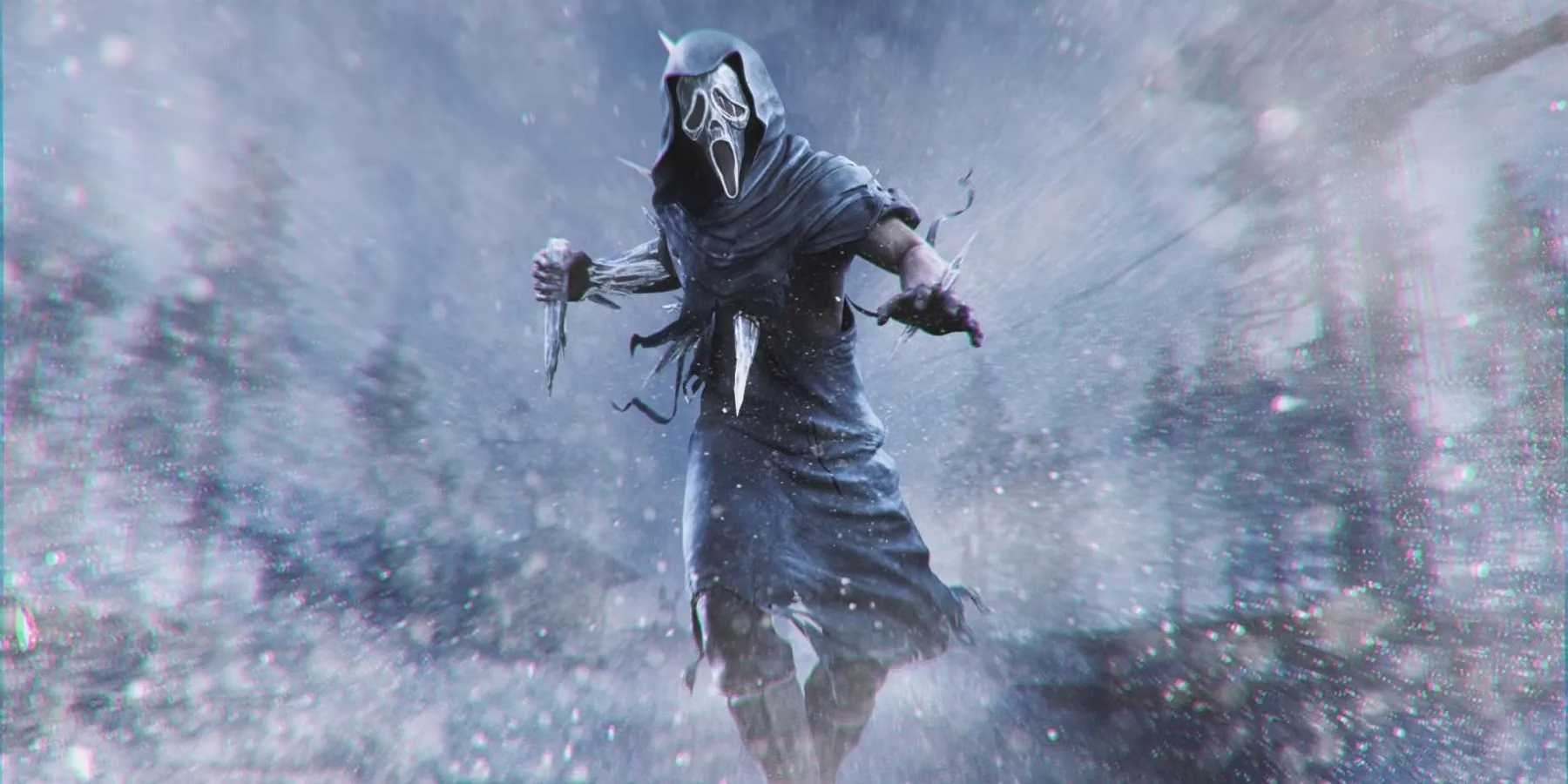
In Dead by Daylight, every creak, every thump, every shrieking chord is a thread in a tapestry of dread. Killer mains learn to exploit audio like a falconer uses a lure; survivors, in turn, survive by mapping those same sounds to precise threats. A blown generator? That’s a dinner bell. A fast vault? A neon arrow pointing to a potential chase. The terror radius itself is more than just background noise — it’s a proximity alarm painted in sound, a red stain you hear before you see. And for Ghostface, whose entire playstyle orbits around peeling away that warning to sneak up close and personal, the music becomes a psychological weapon as much as a mechanical one. Imagine an alarm clock that instead of buzzing, whispers your name in a language you almost understand — that’s the tension these themes introduce.
When Behaviour first gave Legion a new chase theme, then soon after gifted Ghostface his own, the community fractured into the usual camps: lovers of the fresh and defenders of the classic. The old Ghostface theme had a certain lumbering menace, a reliable growl that shouted “movie monster.” The new one? It’s a slow burn, a haunt that builds like a migraine before snapping into a chase track that’s less a sprint and more a nightmare ballet. The transition is what gets you: the terror radius part hums with a cold, mechanical subtlety — like hearing your own heartbeat through a stethoscope while someone else holds the other end. Then, when Ghostface commits, the chase music erupts into a fractured, rhythmic pulse that feels like running downhill with a cinema reel unspooling in your brain. It’s disorienting, yes, but utterly brilliant.
As a survivor, you rely on auditory muscle memory. You hear Huntress’s lullaby, you know she’s approaching, radius or not. You hear Freddy’s eerie singsong, you start scanning for dream snares. But Ghostface’s new theme doesn’t just announce his presence — it messes with your threat assessment. Because his power allows him to stalk from behind cover, often hidden by the Undetectable status, that new music can suddenly materialize at a moment when you thought you were safe. The theme’s structure intentionally mimics that deception. The opening notes are faint, almost diegetic, like wind whistling through a cracked window. They blend into the ambient generator hums and environmental creaks in a way the old bombast never did. This sonic ambiguity is a masterclass in asymmetrical design, turning every match into a session of paranoid eavesdropping.
Perks further twist this auditory puzzle. Tinkerer, for example, can suddenly silence the terror radius entirely when a generator nears completion, making Ghostface appear as if from the ether with that unnerving music as the only warning once proximity returns. Then there’s the moment when you spot the red cone that represents the killer’s field of awareness in the survivor’s UI. Normally, survivors gauge safety by that visual cone plus the terror radius’s volume. But Ghostface, ever the trickster, can creep in a crouch, removing both his red stain and his radius, stacking Stalk on you from a corner until the moment he stands — and that new chase theme pierces the silence like a needle through canvas. I’ve seen teammates stand still, bewildered, their character model twitching as if to say, “Is that the killer or just really aggressive background music?” That confusion is exactly what makes a good Ghostface player lethal.
Adapting wasn’t easy. For months after the change, I’d waste precious seconds trying to place the musical cue, my brain flipping through a rolodex of killer themes before landing on the right one. Some players still cling to the old theme’s familiarity, and I get it — nostalgia is a thick blanket in a game that constantly evolves. But embracing the new audio is like learning to read a language that’s 90% silence and 10% dread. Once you internalize it, you start picking up on nuances: the very start of the terror radius has a subtle, ticking percussive element, almost like a clock counting down to your inevitable chase. In 2026, with years of collective ear-training under the community’s belt, high-level survivors can now distinguish a stalking Ghostface from a roaming one just by the tension of the pre-chase layers. That evolution feels earned, a communal triumph over a developer’s cleverly laid trap.
Of course, not everyone loves the change even now. Forums occasionally bubble up with “bring back old Ghostface theme” threads, and I suspect that tension will never fully dissolve. But that’s the nature of live-service horror — it has to churn and remake itself, shedding skin like a snake that’s grown too large for its own mythos. Behaviour’s commitment to updating killer identities, from visual overhauls to auditory reboots, keeps the fog feeling alive rather than a museum piece. Ghostface’s new theme, love it or loathe it, is an audio monument to that philosophy. So next time you load into a trial and hear that spectral waltz curling around the nearest wall, take a split second to appreciate the craftsmanship. Then, for the love of the Entity, run.